

Law Courses after 12th: Applications are being accepted for Law courses after 12th for the academic session 2026-27. Several top universities are accepting admission forms for these courses, such as Manglayatan, IMTS, and Dr Preeti Global. Law programs are designed for individuals willing to explore the enforcement, formulation, and broader concepts of the legal system through specialized study. For working professionals or those who are not able to attend traditional classes. Online law programs provide a flexible and convenient alternative to pursue a legal education.
To pursue law after the 12th, individuals must have passed 12th grade from a recognized board. Law courses after the 12th are typically 5-year integrated programs like BBA LLB, BA LLB, or B.Com LLB. The core law subjects included and taught in these degrees include the Law of Contract, Constitutional Law, Criminal Law, and Family Law. Program fees for law courses after 12th range from INR 16,000 to INR 46,000. Students interested in law courses after 12th can visit the official website of the selected university before the deadline of 15th October 2026. To know more about law courses, read the article below.
Law Courses After 12th Admission Latest Updates

- IMTS Institute has opened the admission process for the LLB Course after 12th for the new session. Students can fill out the application form till 15th October 2026.
- Mangalayatan University Law courses admission has begun for students who have completed Class 12. Interested students can enroll online in batch 2026-27 before the deadline, 14th October 2026.
Law Courses After 12th Highlights
| Course Name | Law Courses |
| Duration | 3 to 5 Years |
| Admission Process | Online |
| Eligibility | 12th Pass with 45% marks |
| Offered By | IMTS Institute |
| Approved By | UGC / DEB |
| Fee Structure | Rs 16,000 to Rs 46,000 |
| Level | Bachelor Level |
| Type | Distance |
Law Courses After 12th
Law courses after 12th registration have started at several institutes and universities, like Subharti University, IMTS Institute, Dr Preeti Global University, and Mangalayatan University for the 2026-27 academic session. Top educational options include a Diploma in Intellectual Property Rights (IPR), Diploma in Cyber Law, and integrated degrees like BA LLB, BBA LLB, and B.Com LLB. To secure admission, candidates usually must qualify for national or university-level entrance assessments such as the Common Law Admission Test (CLAT), LSAT India, or the All India Law Entrance Test (AILET). The last date to register for these courses is 15th October 2026.
Why Law Courses?
In easy terms, law is the rules and regulations created for Indian citizens. Typically, each country has its law, and in India, we follow constitutional law, where there are several articles and sections available to read and follow properly.
The Law course study is all about learning about amendments, articles, and sections. Law study in India is very popular and famous, and the scope of the course is wide and in demand. Law study requires a lot of reading, learning, and remembering the details.
Once students have completed their 12th class need to go through the course structure, where the educational curriculum is all set in a theoretical format and practice to learn the core details related to the course study.
Skill Requirements for Law Courses After 12th
Success in any field demands the student to possess some basic skill requirements. If the students don’t have these skills then they need to work hard to survive in the field. Similarly, in the law prospect, students need to possess some basic skill requirements. Some of the skill requirements are listed below:
- Educational Qualification: Candidates should have passed Class 12th or equivalent examination from a recognized board. Those taking the board exams are also eligible to apply for the law course.
- The memorizing power of the student should be fast, as they will be required to learn about multiple laws illustrated in the Constitution.
- The duration of the law program you choose is based on the category in which it falls; for example, if you choose a UG degree course, you will need to give 3 to 4 years. Choosing diploma and certificate courses will require at least 6 to 12 months.
- If anyone wants to become a successful lawyer, then getting experience of 2 years of practical experience is also necessary.
- It is also very important to pass the entrance exam being conducted at the national, state, or institute level.
Eligibility Criteria for Law Courses After 12th
When a student decides to do a law degree or any other vocational course in law, he or she must be qualified for matriculation and intermediate from an esteemed Institute. There must be a score of 50% obtained by the applicant in the general category or any candidate from the SC/ST category must have secured 45% on an average basis. It is mandatory in all cases to have qualified for a law entrance exam to get entry to top law colleges in India. Some of the entrance exams that are widely known and conducted every year to shortlist candidates for law Courses are LSAT, AILET, CLAT, etc.
- Education: Must have finished Class 12 or equivalent in any stream (Arts, Science, or Commerce).
- Minimum Marks: Students must have scored 45% aggregate (45% for General, 42% for OBC, 40% for SC/ST categories).
- Age Limit: The Bar Council of India (BCI) has removed the upper age limit, making candidates of any age eligible, though university-specific rules may occasionally apply.
Admission Process for Law Courses after 12th
Admission to Bachelor law in India requires completion of Class 12 from any discipline with at least 45% score, clearing a law entrance exam, and completing counseling. The basic steps consist of taking exams like AILET, CLAT, or SLAT to join a 5-year integrated program (BA LLB, BBA LLB).
- Complete your 12th from a recognized board in Commerce, Arts, or Science
- Minimum 45% of marks in general category students (40% for SC/ST/OBC)
- No upper age limit for the Bar Council of India
Step-by-Step Admission Procedure for Law Courses after 12th
Step 1: Sign up on the official portal of the entrance examination
Step 2: Appear for an examination which covers English, general knowledge, and basic math.
Step 3: Get registered for a counseling session according to the score obtained in entrance, choose university and appear for the document verification
Step 4: Download and print out a copy of admission form for future use
Important Documents Required for Law Courses after 12th
- Class 10th Marksheet & Certificate (Date of Birth proof)
- Entrance Exam Admit Card (e.g., CLAT)
- Entrance Exam Scorecard
- Transfer Certificate (TC)
- Migration Certificate
- Character Certificate
- Recent Passport-Size Photographs
- Government-issued Photo ID Proof (Aadhaar, Passport, etc.)
- Category/Caste Certificate (if applicable, e.g., SC/ST/OBC)
Types of Law Courses in India
| Course Type | Course Name | Duration |
| Integrated UG Law course | BA+LLB, BCom+LLB, BBA+LLB | 5 Years |
| Bachelor Law Course | LLB | 3 Years |
| Master Law course | LLM | 2 Years |
| Diploma Law Course | DIPP, PGCCL, PGDCJ | 1 to 2 Years |
| Certificate Law Course | CHR, CCP, CIHL, CAHT, CCLBL | 6 Months |
Law Courses List After 12th
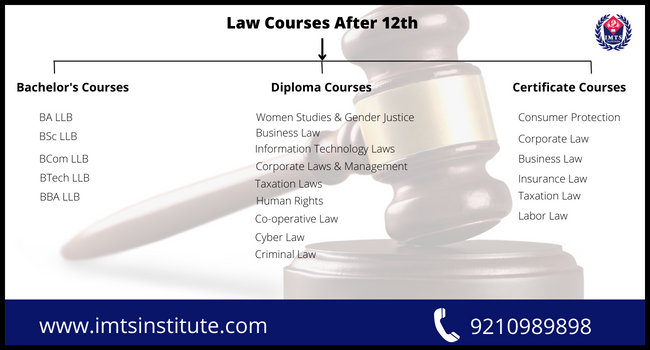
In India, many universities and institutes offer law courses after 12th such as BA + LLB, BCom + LLB, Diploma in Business Law, Diploma in Human Rights, Certificate in Cyber law, and many more. For a better understanding of law courses, students can follow the table below and learn which course is most appropriate for them.
| Law Course | Duration |
| BSL + LLB | 5 years |
| BA + LLB | 5 years |
| BA + LLB (Hons) | 5 years |
| B.Com + LLB | 5 years |
| B.Com + LLB (Hons) | 5 years |
| BSc + LLB | 5 years |
| BBA + LLB | 5 years |
| BBA + LLB (Hons) | 5 years |
| BTech + LLB | 6 years |
| Diploma in Business Law | 1 year |
| Diploma in Taxation Laws | 1 to 2 years |
| Diploma in Human Rights | 1 to 2 years |
| Diploma in Co-operative Law | 1 to 2 years |
| Diploma in Criminal Law | 1 year |
| Diploma in Women Studies & Gender Justice | 1 year |
| Diploma in Corporate Law & Management | 1 year |
| Diploma in Cyber Law | 6 Months to 1 year |
| Certificate in Law (Cyber security, Human Rights) | 6 Months to 1 year |
| Certificate in Law (Corporate Law, Taxation Law, and Labor Law) | 6 Months to 1 year |
| Diploma in Information Technology Laws | 6 Months to 1 year |
| Certificate Course in Consumer Protection | 6 Months |
| Certificate Course in Business Law | 6 Months |
| Certificate Course in Cyber Law | 6 Months |
| Certificate Course in Insurance Law | 6 Months |
| Certificate Course in Corporate Law | 6 Months |
| Certificate Course in Anti-Human Trafficking | 6 Months |
Integrated Law Courses After 12th
The 5-year integrated law courses can be pursued in various institutions in India after completing the 12th grade. A recognized board or institution…. Read more at: https://law.careers360.com/articles/law-courses-after-12th Students can enroll for integrated law courses after completing the 12th class examinations with a minimum score of at least 80% in any stream. In addition, there are a number of 5-year law courses, such as BA LLB.
Which is provided by students after their 12th Arts, and BCom-LLB, which is provided by students after their 12th Commerce. It is important to note that the fees for these types of law courses vary depending on the stream and the institution.
BA LLB
This 5-year integrated law course after the 12th is offered in many institutes in India. BA LLB is a highly chosen course by students who have an interest in the law field. This professional law course enables one to start legal practice. In India, to get into the BA LLB course, one must appear in national-level entrance tests like CLAT, AILET, LSAT & more.
Percentage criteria may vary according to the university. Some other law courses after 12th are mentioned below.
- BCom+LLB is a five-year integrated UG degree program that is a combination of commerce and law, offering students the opportunity to get expertise in both business and legal fields.
- BTech+LLB is a 6-year integrated degree program that combines the Bachelor of Technology (B.Tech) engineering degree with the Bachelor of Legislative Law (LL.B) law degree.
- BBA+LLB is a 5-year integrated undergraduate degree program that combines business administration and law studies, and prepares graduates for various careers in the business and legal fields.
- BSc+LLB is a 5-year dual UG degree programme, combining the Bachelor of Laws (LLB) degree with the Bachelor of Science (BSc) degree. It provides scientific and legal education, preparing students to get jobs in different sectors like technology, healthcare, and the environment.
- BA+ LLB is a 5-year integrated undergraduate degree program. It is a combination of dual degrees, which is a Bachelor of Arts with Bachelor of Laws. In this course, students gain knowledge about liberal arts education and legal education.
Law Courses After 12th Salary
After completion of the law courses, the salary for freshers can range anywhere from ₹3 Lakh to ₹6 Lakh per annum, and experienced candidates can earn ₹8 Lakh to ₹15 Lakh per annum. Candidates can make their career in various specialisations such as corporate lawyer, intellectual property attorney, criminal lawyer and legal consultant.
Entrance Exam for Law After 12th
To pursue law course study after passing class 12th grade in top institutes in India. Students are required to appear in several law entrance exams after 12th at the national level in India. Many government and private law colleges like NLU and Lloyd Law College & more accept a valid law entrance test scorecard of CLAT, AILET, LSAT, SAAT, & more. Only students who have passed the 12th class with a minimum of 45% marks are eligible to apply.
Law Courses After 12th Science
Students completing 12th grade with a science background who want to pursue Law courses. There are so many Law courses available, including integrated law programs like BA LLB, BSc LLB, BBA LLB, and BCom LLB. This is a three-year LLB after completing a Bachelor’s degree in science, BSc LLB.
Law Courses After 12th Commerce
After completing class 12th with the commerce stream, Students can gain a Deeper Understanding of the law. Students who have completed class 12th with the commerce stream can definitely pursue law courses, and they will be able to apply their knowledge in a professional capacity.
Commerce students pursue law courses like BBA-LLB, BCom-LLB, and LLB. This course can provide deep knowledge about property law, taxation, laws, torts, company law, and many more.
Law Courses After 12th Arts
Law courses after 12th arts are generally common options for most interested students. After pursuing the class 12th from the arts stream, students can opt for admission into an integrated LLB program, for which they apply to get admission into the Bachelor of Arts, commonly known as the BA.
Generally, law courses after 12th arts last three years if pursued after a bachelor’s degree or five years if pursued in an integrated course. Students get admission to law courses after 12th grade by taking preliminary exams at recognised institutions. Students can enrol in several courses, such as BA-LLB and BSc-LLB.
Law Diploma Courses After 12th
Students can pursue a law Diploma course after completing 12th grade. This diploma course can provide knowledge in areas like Cyber Law, Intellectual Property Rights, and Business Law. This course typically 1 1-year program that enhances skills and career. Students can also pursue an integrated course like BA LLB, BBA LLB, and B.Com LLB.
What are the 4 main types of law?
There are many types of law specialization a student can pursue after completing high school from a recognized board. Below are the 4 main types of law categories:
- Criminal Law
- Civil Law
- Family Law
- Environmental Law
Criminal Law Courses After 12th
Criminal law courses stand for those courses that are specialized in the practices linked to criminal offenses. Students who have an interest in learning in detail about the rules and regulations related to criminal law should opt for criminal law courses after the 12th.
There are several bachelor’s and diploma courses after 12th in the criminal law specializations that students can opt for admission so that they can go for a successful career. The mode of admission for most of the criminal law courses after the 12th is generally based on the applicant’s qualifying scores in the preliminary exam.
Corporate Law Courses After 12th
Corporate Law is the best and most well-known course in India. Corporate Law gives deep knowledge of sole proprietorship, corporations, partnerships, etc. With the help of Law, Students will be able to understand the legality of commercial transactions, manage government reporting, file taxes, etc.
Corporate Law is offered at all levels, such as undergraduate and Postgraduate. Those who want to pursue UG-level Corporate Law can specialise in business law for three years. On the other hand, postgraduate-level corporate law candidates can specialise in the field of Law.
How to become a lawyer after 12th?
To become a lawyer in India after passing class 12th, students need to pursue an integrated bachelor’s degree in law such as BA LLB, BBA LLB, BCom LLB, etc & more. Also, first, students can complete their graduation and then pursue an LLB degree. Students must get into law studies in order to make a career as a lawyer. Many top institutes conduct law entrance tests to provide admission. Also, to become a specialized lawyer in Civil, criminal, family, and real estate law depends upon the law course specialization.
Which Law Course is Best After 12th?
Law courses are an opportunity for students aspiring for a career in the judiciary and law prospects. Students who have completed their 12th class and have an interest in law can opt from the multiple options in courses provided by the institutions.
Depending on their interests and priorities, students can choose a diploma or bachelor-level course. A diploma-level course enables them to gain an overview of law courses, while a bachelor’s course like LLB requires the applicant to have completed a bachelor’s course like BA, BSc, etc., as a prerequisite.
6-Month Certificate Law Courses After 12th
Those who are searching for the best certificate programs in the law field after completing the 12th standard. There are various certificate courses available, such as Certificate in Cyber Law, Certificate in Corporate Law, Certificate in Anti-Human Trafficking, and many more. Some of the courses list, we are attached in the given section.
Law Courses After 12th Fees
The students who are pursuing a law course or aspiring to appear in law courses after 12th have to pay a fee that can vary as per the level of the course and the quality offered by the institution. The fee can also vary as per the mode; if the student is pursuing a course in the regular mode, the fee can be higher, and in the distance mode, it can be lower.
The fee structure for various law courses after 12th is listed below:
| Course Name | Average Fees |
| BA LLB |
INR 3,720 – INR 8,00,000
|
| Bachelor of Law [LLB] |
INR 2,900 – INR 6,94,000
|
| Certificate in Law |
INR 1,400 – INR 27,000
|
| Diploma in Law |
INR 6,500 – INR 50,000
|
Law Courses After 12th: Career Scope and Opportunities
Students who have completed the law course can find jobs in various roles with high-paying income in different sectors like the IT sector, government sector, finance sector, etc. The following are some of the job profiles that candidates can join:
- Legal Advisor
- Corporate Lawyer
- Judiciary Services
- Litigation (Court Practice)
- Legal Journalism
- NGO or Human Rights Work
- Civil Services (UPSC)
FAQs of Law Courses After 12th
Q1: Which law course is best for the future?
Ans: LLB (Hons) is the best degree for the future. It is a 3-year degree program spread over 6 semesters. Students undertaking this program are taught about criminal law and justice to provide them with a comprehensive understanding of the Indian criminal justice system.
Q2: Can I do LLB after completing 12th with commerce?
Ans: Yes, students who completed Class 12 with the Commerce stream are eligible to do LLB. Candidates with a commerce background can pursue BALLB and BComLLB.
Q3: Which law course is best for science students?
Ans: To study law along with science, one can consider doing a B.Sc LLB (Bachelor of Science and Bachelor of Legislative Law) course. This course enables interested students to learn scientific subjects such as Physics, Chemistry, Biology, etc. Also, it covers legal topics like contract law, legal principles, etc.
Q4: What are the courses for cyber security law?
Ans: To pursue a Cyber Law course, it is necessary to have a bachelor’s degree in any field and only one can enroll in an LLB program. After completing LLB, students can further their expertise by opting for LLM in Cyber Law.
Q5: Can I do LLB after 12th science
Ans. Yes, students who have completed class 12th with a science Background are eligible to pursue a Bachelor of Laws degree. Law programs are allowed for all stream students.
Q6: What is the minimum percentage required for LLB after 12th?
Ans. The Minimum percentage required to pursue LLB after 12th is that Students must have scored a minimum of 45-50% marks in 12th grade.
Q7: What is the last date for admission to law courses after 12th?
Ans: Applicants can register online for Law Courses after 12th admission before the last date of 15th October 2026 in 2026-27 academic session.