

Civil Engineering Courses after 12th Grade: Applications are currently being accepted for Civil Engineering Courses after 12th for the academic year 2026-27. Reputed universities like Dr Preeti Global, IMTS, Subharti, and Manglayatan are offering civil engineering courses after 12th. Civil engineering courses focus on the planning, design, construction, and maintenance of physical infrastructure. Students who have completed their 12th in Physics, Chemistry, and Mathematics are always willing to pursue engineering courses.
Diploma in Civil Engineering, B.Tech in Civil and Environmental Engineering, B.Tech in Construction Engineering, and B.Tech in Transportation Engineering are the courses which students can pursue after completing their 12th from an approved board with a minimum of 45% to 50% marks. The syllabus for civil engineering courses after 12th consists of Water Resources, Structures, Geotechnics, Transportation, and Construction Management. Program fee generally ranges from INR 10,000 to INR 2,70,000. The last date to apply for Civil Engineering courses is 30th September 2026. For further details related to eligibility, fee structure, and admission process, read the article below.
Civil Engineering Courses after 12th Admission: Latest Updates

- IMTS Institute is providing admission to the civil engineering course after 12th for the academic year 2026-27. The candidate can apply before the deadline of 30th September 2026.
- Civil Engineering Courses after 12th admission is ongoing at Dr Preeti Global University for the academic session 2026-27. The last date to apply for Civil Engineering courses is 29th September 2026.
Civil Engineering Courses After 12th Highlights
| Course Name | Civil Engineering Courses |
| Duration | 3 to 4 Years |
| Admission Process | Online |
| Eligibility | 12th Science Pass with 45% marks |
| Subject Required | Physics, Chemistry & Mathematics |
| Offer By | IMTS Institute |
| Approved By | UGC / DEB |
| Fee Structure | INR 10,000 – INR 2,70,000/- |
| Level | Bachelor Level |
| Type | Distance |
Civil Engineering Courses After 12th
Civil engineering courses are 3 to 5-year programs focused on designing, planning, and constructing infrastructure like roads, bridges, and buildings. After 12th grade, students can either earn a 3-year diploma or a 4-year bachelor’s degree. Core topics include surveying, structural analysis, and fluid mechanics, with a heavy focus on sustainable practices. The admission portal is currently open at reputed universities like Subharti, Manglayatan, IMTS, and Dr Preeti Global.
Top post-12th options include B.E., B.Sc., B.Tech, and Diploma programs in Civil Engineering. Students can also earn professional certifications to make their resumes stand out and build practical skills. To apply, go through the official website of the chosen college or university and check the eligibility of the program. Last date to enroll is 30th September 2026.
Why Civil Engineering Courses?
Civil Engineering is the branch of engineering that tends to teach students about various prospects related to building and construction. Students who have an interest in redefining construction activities and methods should opt for civil engineering courses after the 12th as it will help them pursue a career around their interests.
Students after completing their 12th class, generally have one question in their mind about which course they should opt for a successful career after 12th in India? Civil Engineering courses after 12th are among those few courses that offer students the opportunity for a successful career.
Civil Engineering Courses After 12th Important Points
- Eligibility Criteria: Students must have passed 12th of any recognized board with 50% or more marks. They have passed from the science stream with Physics, Chemistry, and Mathematics.
- Program Duration: Civil Engineering course duration depends on the course, and it ranges from 6 months to 4 years.
- Course Curriculum: The syllabus of the course includes the study of environmental engineering, Engineering Physics, Environmental Science, Engineering Chemistry Lab, and more.
- Career Opportunities: Students after completing the study of civil engineering courses can apply for multiple job roles in the government sector, private sector, research organization, consulting firm, construction companies, and more.
- Average Salary: After completing the course, students can earn a salary for such job position in the range of INR 3 LPA- INR 5 LPA which varies depending on the job position.
- Flexibility: Students get the opportunity of flexibility in the curriculum of the course so they can manage their work and jobs together as per their schedule.
Some of the Popular Civil Engineering Courses After 12th:
Students complete after 12th class, there are many courses like B.Tech in Civil Engineering, Diploma in Civil Engineering and other specialized courses like Modelling, Construction, and many more. Students can check civil engineering courses list of popular courses.
- Mechanical Engineering: Mechanical Engineering undergraduate bachelor’s degrees, for a B.Tech or BE, are typically four years (8 semesters).
- Chemical Engineering: Chemical Engineering is a 4-year (8 semesters) undergraduate (UG) degree, like a B.Tech or B.E. It is focused on the design, operation, and improvement of chemical processes, aiming to convert raw materials into valuable products.
- Electrical Engineering: Electrical Engineering is about 4 year Undergraduate degree program that is divided into 8 semesters. It provides knowledge of design, manufacturing, and development of electronic products.
- Construction Management: Construction Management Undergraduate degree program is 4 years. It provides theoretical and practical knowledge about budget, planning, maintenance, and supervision of a construction project.
- Geotechnical Engineering: Geotechnical Engineering is a UG Degree program course of 4 years divided into 8 semesters. It is focused on providing theoretical and practical information on soil mechanics and rock mechanics to design and construct structures such as tunnels and landfills.
Civil Engineering Courses After 12th Admission 2026
Admission to civil engineering courses after the 12th is generally conducted by multiple institutions in either the entrance exam process or the merit list process.
The admission process into Civil Engineering is based on both merit and entrance examination scores. Students must meet the minimum eligibility criteria and appear for relevant entrance examinations to get admission into civil engineering classes in reputed colleges in India.
Civil Engineering Course duration ranges from program to program. For the BTech in Civil Engineering course, the duration is 4 years, and for the diploma, the duration will be 2 Years. Students who want to get admission to the Civil Engineering Course after the 12th can read this article fully to avoid missing anything important.
Civil Engineering Courses After 12th Admission Process
The admission process into Civil Engineering is based on merit and entrance exam scores. Students must ensure to meet the minimum eligibility criteria and appear for the relevant entrance examinations to get admission in civil engineering classes in reputed colleges in India.
- Entrance Exams
- Counseling
- Document Verification
- Fee Payment
- Civil Engineering Classes
Civil Engineering Courses After 12th Eligibility Criteria
Getting admission to civil engineering courses after the 12th is subject to completing the eligibility criteria listed by the respective institution. A student who completes the criteria has the chance of getting admission, and one who is unable to do so gets rejected. Some of the basic requirements for admission are:
- A student must be passed the 12th class with PCM stream from any recognized board.
- A minimum of 55% is required to be eligible for admission to civil engineering courses.
- A reservation of 5% is provided to SC/ST/Minorities or reserved category candidates.
- There are no specified age criteria for admission; therefore, students of any age can apply for admission.
- The student will be required to pass the entrance test if conducted by the institution.
Civil Engineering Courses After 12th With Salary
There are 3 types of engineering courses available after 12th, which are B. Tech or BE in Civil Engineering, B.Sc in Civil Engineering, and Diploma in Civil Engineering. After completion of these courses, students will get different types of jobs with a salary of up to ₹15 Lakh per annum.
Below is the list of top job roles with salary:
| Job Role | Salary |
| Site Engineer | ₹3–5 LPA |
| Structural Engineer | ₹4–6 LPA |
| Project Engineer/Manager | ₹5–15 LPA |
| Construction Manager | ₹6–12 LPA |
| Urban Planner | ₹6–9 LPA |
| Facilities Engineer | ₹4.8 LPA |
Civil Engineering Courses After 12th Fees
Civil Engineering Courses after 12th consist of a 4-year Bachelor of Technology, a 3-year diploma, and a 1-year certificate course. Fees generally range from INR 10,000 to INR 2,70,000 with an application fee of INR 500 to INR 1500 (non-refundable). Fee structure can vary depending on the institute. For more information related to the fee range, check the table below.
| Universities Name | Fee Range |
| Dr Preeti Global | INR 2,70,000 |
| Subharti University | INR 32,000 |
| Manglayatan University | INR 55,000 |
| IMTS | INR 10,000 |
Civil Engineering Courses After 12th Salary
Upon completing high school, candidates who are interested in building a secure career in the construction field can take admission in Civil Engineering courses. Students can take admission in B.Tech in Civil Engineering as it is one of the most popular courses. The salary of a civil engineer can vary depending on experience, skills, and specialisation. The starting salary of B.Tech in civil engineering for a fresher can range from INR 3-6 lakh per annum, and the diploma in civil engineering salary can range from INR 2-3 lakh per annum.
Top Entrance Exams for Civil Engineering Courses
Students who are interested in Civil Engineering Courses are required to appear in various entrance exams such as GATE, AMUEE, JEE Main, MHTCET, WBJEE, and many more. Below, we have listed some of the popular entrance exams for the Civil Engineering course.
- JEE Main
- JEE Advanced
- BITSAT
- KCET
- Gate
- AMUEE
- VITEEE
- MHTCET
- WBJEE
- SRMJEEE
Civil Engineering Courses After 10th
After 10th Civil Engineering Courses are available at the Diploma level. Civil engineering is a branch of engineering that provides opportunities for students to learn in brief about various construction-related activities. Students who have completed their education at the 10th level can opt for a Diploma in Civil Engineering. The duration of the Diploma of Civil Engineering is 1 to 3 years.
- Diploma in Civil Engineering
- Diploma in Transportation Engineering
- Diploma in Civil Infrastructure Engineering
Diploma in Civil Engineering: It is a short-term course, which requires 3 years to complete the course. Students after completing their 10th, can also get admission after qualifying the polytechnic entrance exam. 150 questions are asked in this test. Some universities give admission to students in Diploma in Civil Engineering based on Merit.
Diploma in Civil Infrastructure Engineering: It is a technical course that needs a minimum of 3 years to complete the course. However, a student can take a maximum of 6 years to complete the diploma degree. Interested students who have done 12th in science. They are interested in making environmentally friendly infrastructure of buildings that can be used as schools, corporate offices, etc.
Diploma in Transportation Engineering: Students who want to build their career in Transportation Engineering can enroll in a Diploma in Transportation Engineering. It is a very important diploma program that helps students to establish their careers in a short time. Students shall get the skills to work effectively on designing, building, and maintaining highways.
How to become a civil engineer after 10th?
To become a Civil Engineer after completion of class 10th, students can pursue three year Diploma in Civil Engineering. Alternatively, Students can complete class 11 or 12th with the science stream. They are mainly focused on planning, designing, execution, and maintaining structural works like bridges, buildings, and roads.
Why Diploma in Civil Engineering Courses After 12th?
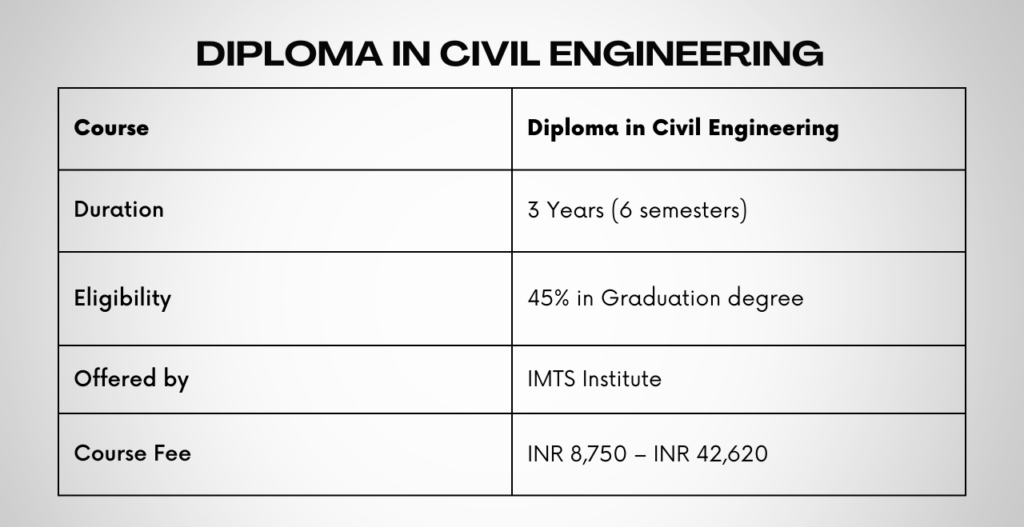
A diploma in civil engineering is a 3-year course that is offered by several institutions to prepare students with the basic skills and information that are necessary for applicants to get into civil engineering.
Students who have passed their 12th class with maths as one of the essential subjects can apply for admission in a diploma in civil engineering course after 12th if they have got a minimum of 45% score in it.
Civil Engineering Course after 12th: Specializations
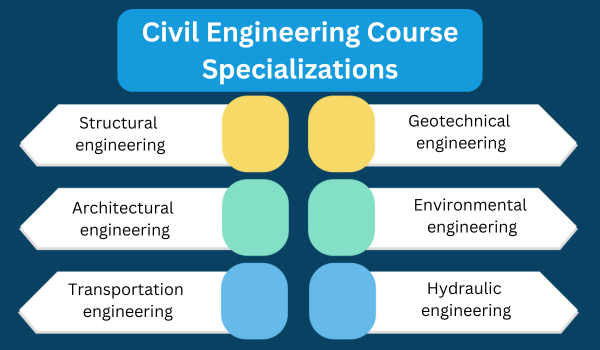
The Civil Engineering course is modified, and expansion is helping students with their educational growth. There is a variety of specializations available for students who want to choose something different from the general course. Below, we are providing the list of courses that are specializations in Civil Engineering.
- Structural engineering: Structural engineers ensure that structures can withstand the stresses and strains by use and the environment. They calculate stability, stiffness, and strength and use the right materials for each project.
- Architectural engineering: Architectural engineering, also known as building engineering. It is a discipline which is focuses on the construction of buildings, mechanical, electrical, and environmental systems.
- Transportation engineering: It is a branch of civil engineering that involves the planning, design, operation, and maintenance of transportation systems to help build smart, safe, and livable communities.
- Geotechnical engineering: Geotechnical engineering is a part of civil engineering focused on studying the behavior of earth materials like soil and rock. It is used to ensure the safety and provide efficient structures for design and construction, like bridges and tunnels.
- Environmental engineering: Environmental engineering is a 4-year undergraduate program concentrated on the principles to develop solutions to protect people’s health and the surrounding environment.
- Hydraulic engineering: Hydraulic engineering is a part of civil engineering that gives candidates the opportunity to learn how to apply the principles of fluid mechanics in the design, construction, and maintenance of systems involving the flow of water and other fluids.
Diploma in Civil Engineering
A diploma in civil engineering is a 3-year polytechnic-level course that focuses on planning, designing, constructing, and maintaining the infrastructure. This course prepares students for junior engineer roles in a construction company. Students have the opportunity to gain new skills and improve existing ones that are relevant to the civil and construction business when they enrol in the class. This credential is part of the Civil Engineering Courses that students can take after the 12th.
The scope after completing this course is very vast, as the students can get to work constructing buildings, roads, infrastructure, etc.
BTech in Civil Engineering
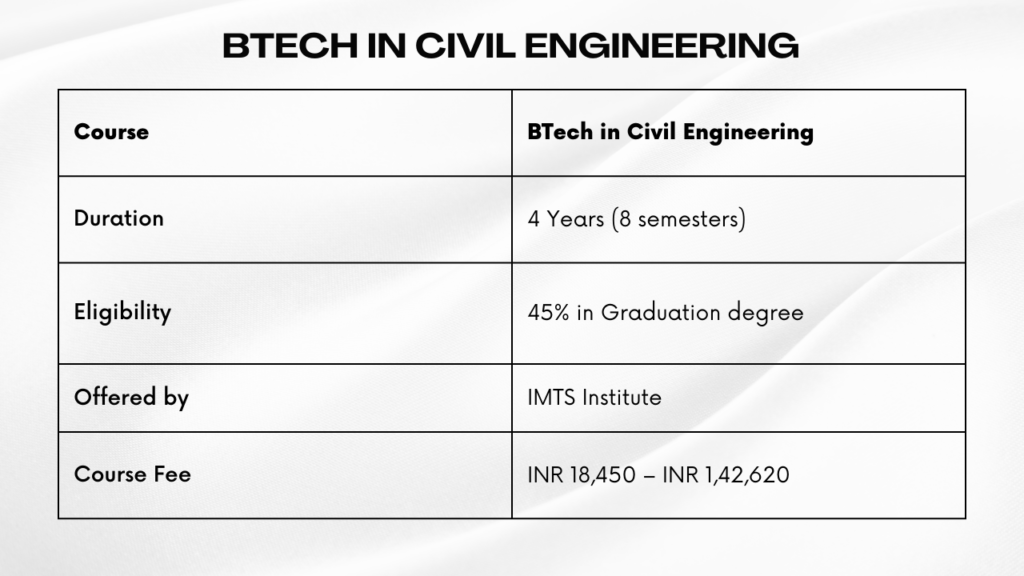
B.Tech in Civil Engineering program is a 4-year graduation degree that focuses on Planning, building, and construction, like buildings, roads, bridges, canals, etc. Candidates who have passed with 50% marks in subjects such as Physics, Chemistry, and Maths are eligible for admission in the top B.Tech Civil Engineering colleges based on JEE Main and JEE Advanced scores.
BE in Civil Engineering
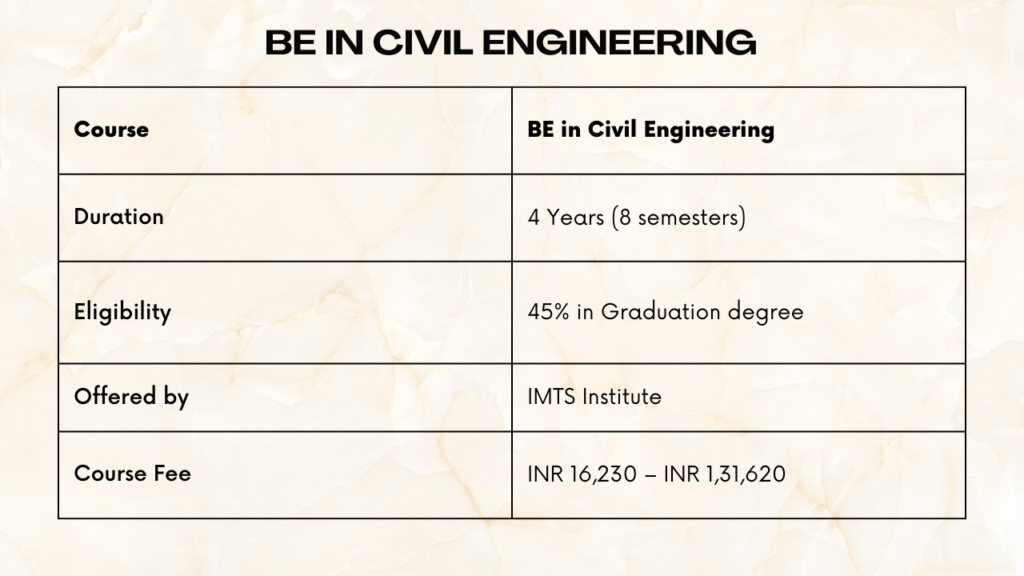
There are four years of study for the BE (Bachelor of Engineering) in Civil Engineering. This course is designed to provide students with a solid understanding of the field of civil engineering Through the provision of technical knowledge. This discipline encompasses a wide range of important and basic elements, both theoretical and practical, that can be addressed by all students.
Civil Engineering Courses after 12th Arts
Civil Engineering courses after 12th arts admission are currently ongoing at Mangalayatan University, IMTS Institute, Dr Preeti Global University, and Subharti University for 2026-27 session. Students after passed class 12th with the arts stream and still have to pursue many civil engineering course after 12th arts like Diploma in Civil Engineering, a B. Tech in Civil Engineering, or a B. Sc. in Civil Engineering, and students can pursue various specialized courses and certifications like construction management or environmental engineering.
Civil Engineering Courses after 12th Commerce
Students who want to pursue a career in Civil Engineering course after 12th with a commerce background then they’re not eligible for the course. Civil Engineering courses require a strong Science background, like Physics, Chemistry, and Math (PCM). Students can pursue diploma programs, engineering management.
Diploma in Civil Engineering after 12th Commerce
Numerous 12th commerce students have found civil engineering to be of interest to them. In such cases, they perform examinations to determine whether or not it is feasible.
There are several diploma-level civil engineering courses available after 12th grade, such as the Diploma in Civil Engineering After 12th Commerce. Students who want to pursue a civil engineering course but don’t have science subjects in 12th grade can take advantage of this diploma program.
Civil Engineering Courses After 12th Scope
Civil engineering courses after the 12th are the most selective courses that students nowadays allow students to explore good careers. In India, civil engineers can earn anywhere between INR 4 lakh to 9 lakhs depending on what role they play in the company. check out the working areas mentioned below:
Employment Area
- Government Department
- Real Estate Societies
- Power Plants
- Transportation
- Teaching Institutions
- Consultancy Firms
- Private And Public Sector Undertakings
- Teaching Institutions
Steps to Become a Civil Engineer
Some important Steps can be followed to learn how to become a Civil Engineer, here are some given steps are as follows :
- Decision Making
- Subjects Choices
- Entrance Exam Preparation
- Selecting Correct Colleges
Career Opportunities after Completing Civil Engineering Courses after 12th with Salary
Multiple job roles are available after completing Civil Engineering Courses after 12th, such as Site Engineer, Project Manager, Transportation Engineer, Urban Planner, and many more. Salary for these roles may vary accordingly. It generally ranges from INR 3.5 LPA to INR 15 LPA. For more information related to salary, role, and responsibilities, check the table below.
| Job Role | Core Responsibilities | Expected Salary Range (INR) |
| Site Engineer | Overseeing daily operations on construction sites, managing labor, and ensuring quality control. | INR 3.5 LPA – INR 7 LPA |
| Structural Engineer | Designing the structural components of buildings and bridges to ensure they are safe and stable. | INR 5 LPA – INR 12 LPA |
| Project Manager | Managing budgets, timelines, and coordination between clients and construction teams. | INR 7 LPA – INR 15 LPA |
| Transportation Engineer | Planning and designing roads, highways, and smart transit systems. | INR 5 LPA – INR 9 LPA |
| Geotechnical Engineer | Analyzing soil and rock properties to design safe foundations. | INR 4.5 LPA – INR 8.5 LPA |
| Urban Planner | Designing smart cities, land use, and public infrastructure layouts. | INR 6 LPA – INR 11 LPA |
What are the Subjects in Civil Engineering
An undergraduate civil engineering course mainly covers about 50 to 60 total subjects which will include lectures, practical labs, and projects across 8 semesters in 4 years. Key core areas include fluid mechanics, structural analysis, and surveying.
- Engineering Mathematics: Calculus, differential equations, and linear algebra.
- Engineering Physics & Chemistry: Basic scientific principles for materials and reactions.
- Engineering Graphics / Drawing: Technical sketching, projections, and computer-aided drafting (CAD) basics.
- Engineering Mechanics: Study of forces, motion, and structural balance.
Frequently Asked Questions?
Q1. Which course is best for civil engineers?
Ans: To become a Civil engineer, candidates can take admission in various civil engineering courses. Some popular Civil Engineering courses are Diploma in Civil Engineering, B.Tech in Civil Engineering, BE in Civil Engineering, and Diploma in Civil Infrastructure Engineering.
Q2. How to become a civil engineer after 12th
Ans. To become a Civil Engineer after completing 12th, Students can typically need to pursue a Bachelor of Technology or Bachelor of Engineering, which takes four years to complete.
Q3: Can I get a job after a diploma in civil engineering?
Ans: After completing a diploma in Civil Engineering, students can be engaged as junior engineers in both sectors – the public and the private.
Q4: What is the difference between BE and BTech civil?
Ans: The BE is theory-oriented, focusing on the fundamentals of engineering, but the B.Tech is application-based, underscoring practical elements of technology. Course Format: BE courses usually have a more traditional process, concentrating on the scientific theory behind engineering principles.
Q5: What is the role of a construction manager?
Ans: Construction managers supervise specialised contractors and other personnel. They schedule and coordinate all the construction processes so that projects meet design specifications.
Q6: Can I do civil engineering after 12th commerce?
Ans: Yes, you can pursue civil engineering after completing a 12th commerce course through a 3-year diploma course.
Q7: What is the last date of Civil Engineering Courses After 12th admission?
Ans: The Civil Engineering courses after 12th admission last date online is 30 September 2026.